
Marble Etching, Marble Etch Repair & Removal in North-East England

Bring the WOW factor back!
Arrange a free demonstration.

Get a Free Quote...

Marble Etching, Marble Etch Repair & Removal

Many stones are what we call acid sensitive.  This is because they contain an element of calcium in them, specifically the likes of Marble, Travertine & Limestone. This often comes from the bones of fish that over thousands of years have formed the stone, in fact one way to identify Limestone is you can often see small traces of shell fossils if you know how to look!

This mineral will burn under acids, causing areas that have come into prolonged contact with say a grapefruit juice spillage, to dull out and ‘etch’.  Most typically these areas will appear more or less in certain lights or from differing angles.

What can we repair & re-surface?

And many more… With care and having consulted many leading suppliers, using approved techniques we can repair most stone & tile without invalidating existing warranties.

Before & After Examples

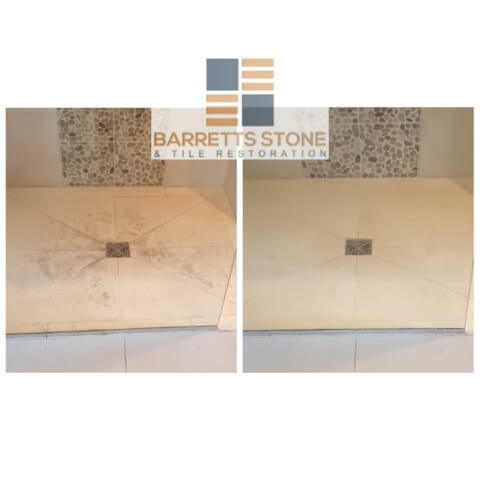
Limestone shower room

Without the right ventilation and a great deal of moisture mould had taken hold within this beautiful Limestone.
Using the correct chemical mix grinding it in and leaving it covered for several days we were able to restore before sealing to prevent further build up.

Marble tabletop

Not just had the table lost it's ping it then suffered a prolific etch mark from an acidic drink marked around the cup.
After removing the etch by grinding down it was then honed and polished up to a WOW factor!

Granite

As a rule the darker the denser & heavier, a very hard stone to work.
This was taken whilst perfecting the process in our workshop. Ground & polished with micro diamonds which are harder than the granite a chemical compound was then used to restore the factory finish.

Polishing Etched Marble

In order to remedy these issues the news is good they can be fully restored 100%.

In fact after a superior restoration they can often be left looking BETTER than new! From the stones initial mining & the finish it is provided with, long haul transportation, shipping, heaving and hoeing even the most careful of deliveries can take a toll on the stone and cause its ever so slight own wear.

The gift is that these etches are commonly limited to the surface of the stone by fractions of a millimetre. You may feel a rougher patch when you run a finger over them but not so much as a scratch which will leave a deeper engraving.

As such by removing what can be as fine as an eight of a millimetre from the surface the damaged stone is forgotten and the integrity of the stone below can now be worked upon to bring back the original or desired finish.

Scratch Removal

How difficult or easy scratch removal may be depends on 2 factors. The harness of the stone itself and the deepness of the scratch.  Granite, due to it’s density it a very difficult stone to scratch which is why you will often find it in kitchen worktops & chopping boards.

Again we are usually talking in tiny millimetres or fractions off here. The entire surface may need to be resurfaced or in some cases with a more skilled hand the scratch can be ‘feathered’ out.

In removing the scratch itself the stone surrounding the area is opened up and may lose some of it’s properties during the process, which will then also need to be restored along with the initial scratch area (SEE POLISHING).

This can play a part in the decision as whether to refinish the whole plane or to concentrate on just the area and surroundings of the scratch itself.
If we feather out the scratch what we mean is that we take down the scratch in the area it resides only. Then with concentric circles pulsating outwards we build up to the original finish, level by level until a close enough match is made with the adjoining stone that a difference is hard to see, if at all.

Alternatively, a complete resurfacing means taking the whole floor or tabletop down to the same level and then refinishing, building upwards, creating a 100% uniform look or to how the stone will allow.

This may be more appropriate in many cases, say where the rest of the surface will look old compared to the newly finished area or the surface of the stone has so many imperfections it may be quicker and more efficient to treat the whole surface.

Areas we cover

Scroll to Top